
The Memory Feedback Loop: How Soaring Consumer Device Costs Could Swing Hyperscaler Earnings

Disclosure: This article is the author's opinion. Not financial advice. Do your own research. Use this link to read the same article on X.
On June 16, 2026, I released an article titled My Grudge Against Memory
It ended up getting a very positive reception, with 500,000 impressions. A lot of people were wondering whether or not I made sense with my underlying message of:
“It doesn’t matter who you ask. Memory is becoming a cost threat to everyone.”

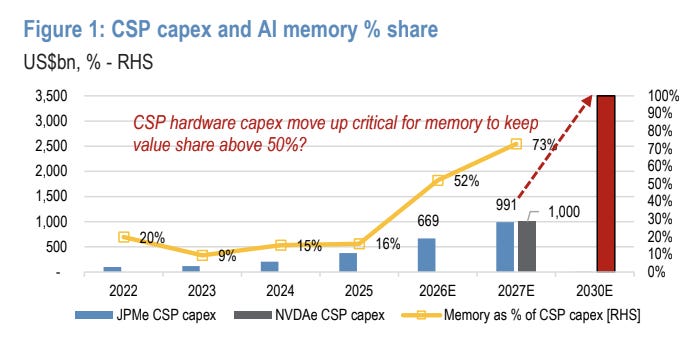
What I highlighted in this article was the large % of CapEx spending allocated towards memory alone, and that % is estimated to be 35-50%, depending on the source you ask. Fast forward, J.P. Morgan is going as far as saying memory % of CSP (cloud service providers) CapEx to reach 52% and 73% in 2026 and 2027, respectively.
However, there is one part I did not address that I intend to in this article. This article is not intended to be highly detailed. I am going to be detailing a scenario that is possible, and what you may see happen over the coming months.
Consider this as a “back of the mind” thought article.
On July 7, 2026, Samsung Electronics reported their preliminary earnings. The earnings were fantastic, and the company reported 2Q26 earnings of:
Revenue: 171.0 trillion KRW (129.3% YoY)
Operating Profit: 89.4 trillion KRW (1811.9% YoY)
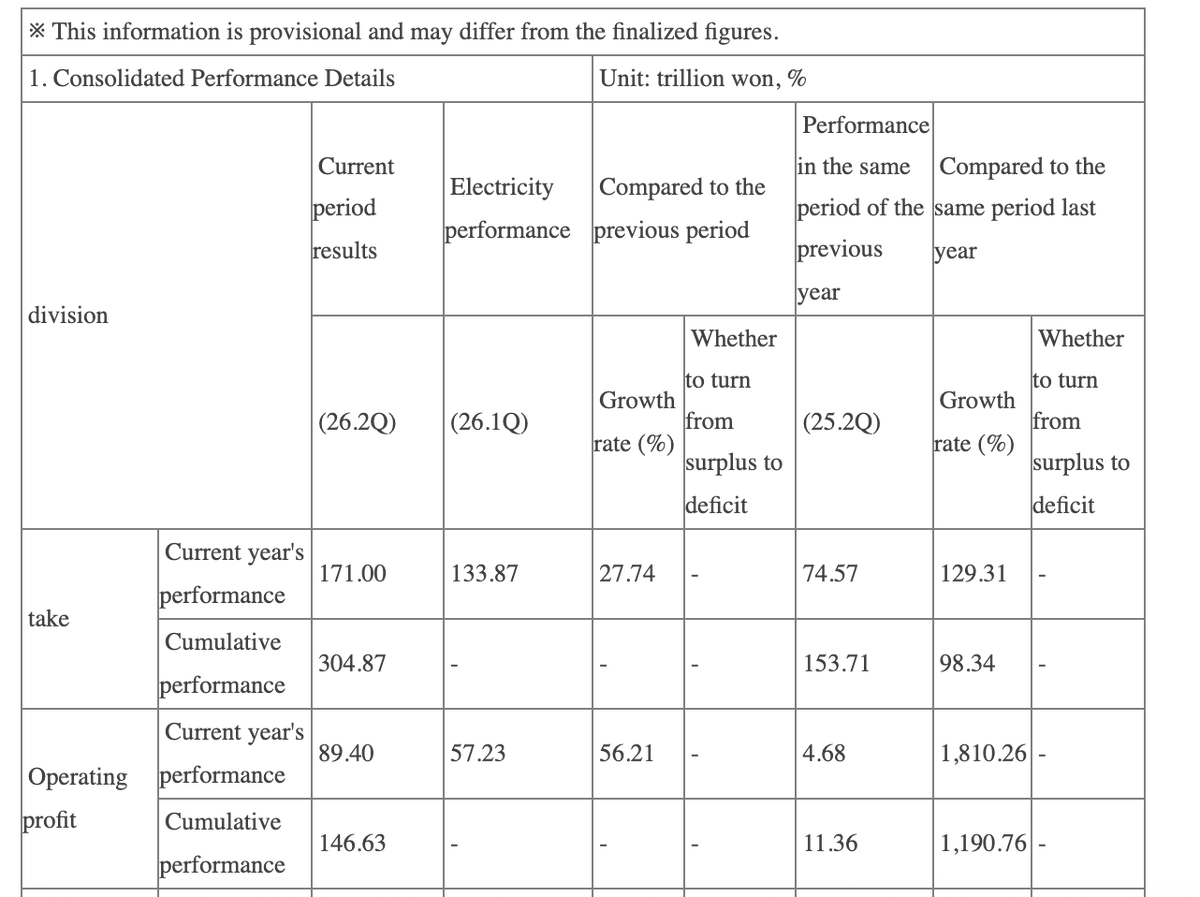
Numbers were excellent...revenue and earnings were robust and Samsung overtook Nvidia as the most profitable company in the world. It all makes sense, because after all, memory is crucial for advanced chips if you want AI to continue progressing.
BUT, one small issue came up in their report: miss on revenue consensus.
Samsung is not SK Hynix or Micron, they are a diversified business that has exposure to consumer electronics (smartphones, television,etc.) and entertainment.
Q2 revenue was 0.7% below consensus, a slight miss. The reason behind this miss? Sales suffering in Mobile eXperience (MX) and Network Business division of Samsung Electronics, which is responsible for the company’s smartphone operations. This was MX division’s first ever quarterly loss since it’s inception in December 2021.
The cost of memory is becoming so significant, that even for a company that is vertically integrated and handling their own memory for smartphones, they can no longer withstand the impact of rising costs.
Samsung Securities has drastically slashed its full-year earnings outlook for the MX and Network Business division from an initial projection of a 3.41 trillion KRW (approx. $2.27 billion USD) operating profit to an operating loss of 5.841 trillion KRW (approx. $3.89 billion USD). Analysts note that the loss, originally expected to hit in the fourth quarter, has been brought forward to the second quarter of this year due to the seasonal off-season colliding with surging memory prices.
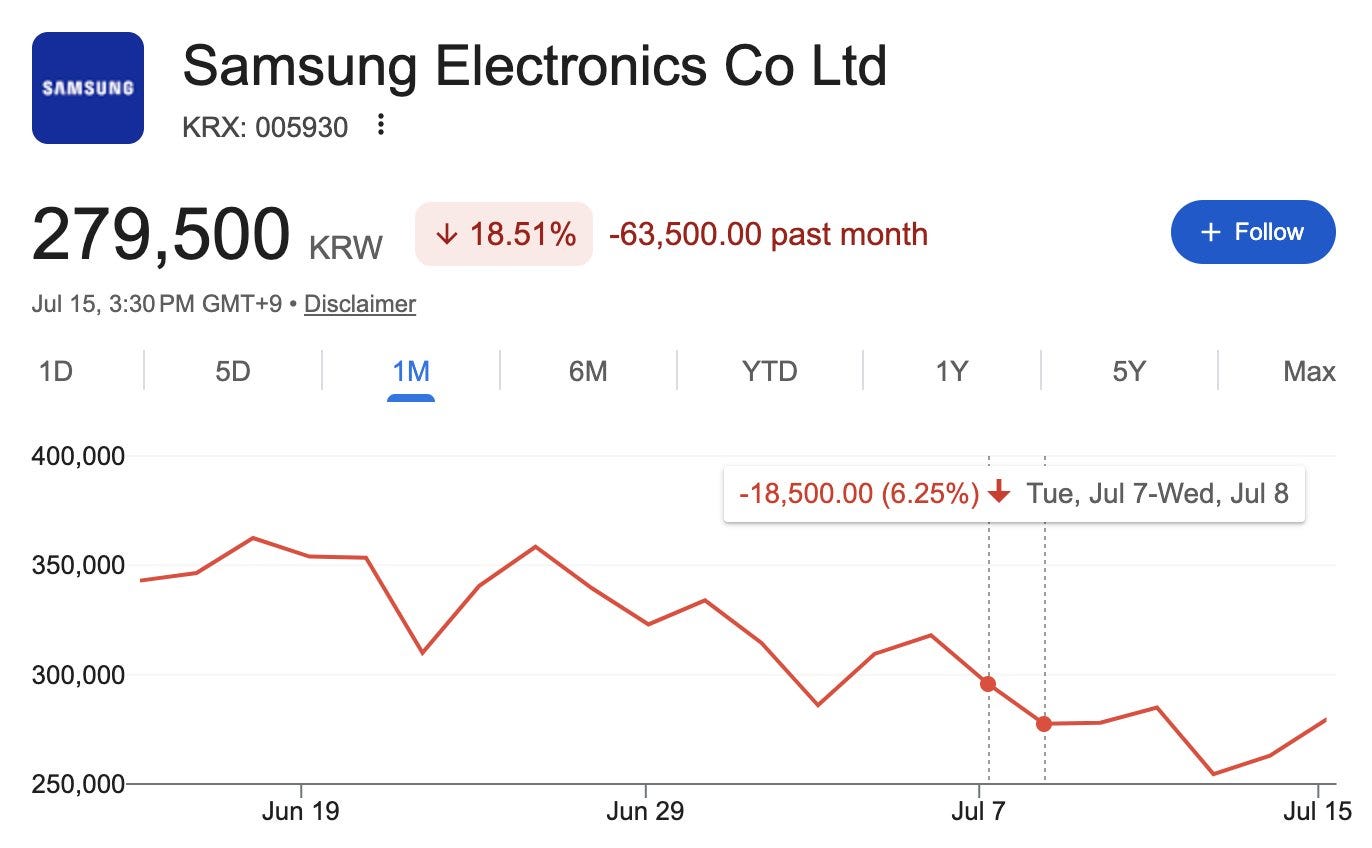
This small revenue miss triggered a 6.25% selloff in the share price, and it has yet to recover the losses from that day.
That makes me question, is anyone pricing in the secondary impact of memory costs on hardware sold by hyperscalers?
Amazon, Google, and Microsoft are expected to be responsible for ~27%, ~25%, and ~26% of CapEx spend in CY26, respectively, which is a total of 78%.
Flip side, they are among the largest companies in the world, with a combined market cap of ~$10T, and almost 10% weight in the S&P500.
Amazon, Google, and Microsoft are not Samsung, meaning they don’t have a large memory business that is growing 100+% YoY. Nor will they ever have one. However, what they do have is a hardware segment in their business just like Samsung, that has been overlooked by their software business.
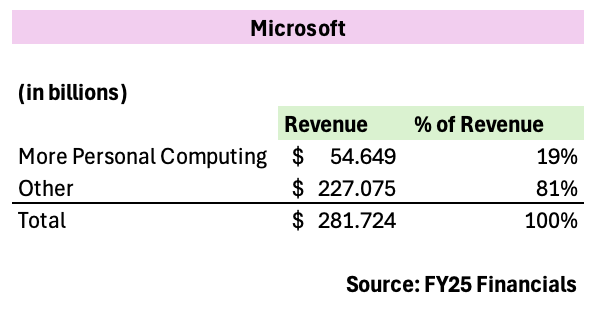
For Microsoft, they sell PCs and the Xbox, this is part of their “More Personal Computing” revenue segment of their business. This is 19% of their revenue, according to FY25 financials. Although, not everything in personal computing is related to hardware, as it includes sales of windows licenses. According to some sources, true hardware revenue is closer to 8-10% of total revenue.
Google, is a business where it is harder to calculate the % of revenue coming from hardware, but notable hardware sales include wearables and smartphones (pixel). Unlike Microsoft, Google has a lower exposure, around 2-3% of total sales, or $8B to $12B sales.
Lastly, Amazon. Amazon is not a hardware provider, technically, but they are the largest ecommerce company in the world and sell many consumer electronics. Depending on the season, Amazon’s electronics retail market share is 25-35% off total ecommerce sales. In other words, $67B to $94B is related to the sales of electronics, roughly, based on FY25 online stores sales.
If memory costs keep rising and are becoming a headwind, how will the earnings of these companies shape up over the coming months? I see 1 of 3 possibilities happening over the coming months or year.
Revenue continues to grow, but the rate of growth may not be as high as anticipated with electronics sales slump offsetting some growth coming from cloud.
Similar to Samsung, these companies may miss revenue consensus one day due to lackluster electronics sales, prompting a severe selloff off of a misunderstanding that makes investors assume “AI spend is failing.”
Hardware becomes downgraded with less memory. Instead of halting production, OEMs begin shipping PCs and smartphones with lower memory baselines. Prompting another impact: delay of edge AI as pushed by Nvidia and Microsoft.
Allow me to further my views on each point:
Point #1:
“Revenue continues to grow, but the rate of growth may not be as high as anticipated with electronics sales slump offsetting some growth coming from cloud.”
On the consumer side, hardware OEMs are facing brutal Bill-of-Materials (BOM) inflation. For example, the cost of standard memory configurations has seen double-digit quarter-over-quarter price hikes. OEMs must either pass these premium costs directly to the buyer (which immediately suppresses demand) or absorb them (which directly erodes hardware margins).
A lot of consumer electronics are highly elastic to begin with. In simple terms, elasticity is how purchasing behavior responds to variables like price changes or income. Hardware like PCs and smartphones do not have “stickiness”, consumers are not forced to stay on a Windows PC or a Pixel smartphone. There are a lot of alternatives. On top of that, these electronics are designed to last for multiple years. If consumers see rising prices due to memory, they will likely wait to buy a new device until prices stabilize or come down. Now, the pushback to this would be Apple, which has historically had inelasticity in their hardware, but it is also considered to be a premium brand with high user loyalty. Nonetheless, not even Apple has ever faced a memory cycle as they have been today.
As a result, even if a hyperscaler’s cloud infrastructure and AI licensing divisions are growing at a 30-40% clip, their consumer product units (like Surface laptops, Pixel devices) represent a significant portion of their blended product revenue. If the consumer hardware segment shrinks by 10-15% as buyers push back on inflated device prices, the aggregate top-line growth rate decelerates.
What you may end up seeing is these tech giants report consolidated revenue growth that sits at the near bottom end of their guidance, flatlining their high-flying growth percentage that you were seeing before memory started taking a real toll.
Point #2:
“Similar to Samsung, these companies may miss revenue consensus one day due to lackluster electronics sales, prompting a severe selloff off of a misunderstanding that makes investors assume “AI spend is failing.”
I consider this point to be unlikely, but could become likely with how costs are trending. One day, Microsoft, Amazon, or Google, or even all three, come out with a slight miss in their consolidated quarterly revenue consensus by a negligible amount, maybe 0.1% of total sales. It would be so small, close to the amount they probably make in a single day or in half a day.
Deep in the footnotes of the SEC filing and in the earnings call, management explicitly attributes the miss to a sharp decline in device sales, noting that they see consumer demand for electronics weakening, with a slump continuing in the foreseeable future.
Meanwhile, Wall Street is currently hyper-sensitized to the “AI ROI” debate. When a market leader misses top-line revenue, high-frequency algorithms and reactive retail desks do not pause to isolate consumer LPDDR5 pricing from enterprise cloud metrics. Instead, the immediate market narrative becomes: “The AI infrastructure bubble has burst, enterprise revenue growth is cooling, and the tech cycle has peaked.” The reaction to this? The stock suffers a severe valuation correction. The irony here is that the miss was actually caused by too much AI data center demand (higher memory costs due to AI chip demand led to cannibalization of hardware sales), yet the market panic-sells under the assumption that there is not enough AI demand.
Point #3:
“Hardware becomes downgraded with less memory. Instead of halting production, OEMs begin shipping PCs and smartphones with lower memory baselines. Prompting another impact: delay of edge AI as pushed by Nvidia and Microsoft.”
Rather than completely halting unprofitable hardware lines, OEMs resort to “margin defense via hardware degradation.” This creates a severe, cascading bottleneck for next-generation local software.
This could be a very likely instance where companies just cut back on the amount of memory to hedge rising costs, and to provide consumers a less expensive product. However, their is a secondary effect in the AI market where edge AI adoption slows due to this.
To run even a modest, highly optimized LLM locally on a laptop or smartphone, the system requires an absolute baseline of 16GB to 24GB of high-speed system RAM. Due to contract price hikes that threaten to double the cost of client RAM, PC and mobile OEMs quietly abandon plans to make 16GB the standard baseline. They keep entry-level configurations capped at 8GB or 12GB to keep device retail prices attractive.
Because the vast majority of the consumer install base is stuck on low-memory devices, software developers cannot ship sophisticated local AI features. The “killer apps” and local agentic workflows heavily promoted by chipmakers and software giants cannot run. The highly anticipated monetization wave of consumer-facing AI software that Jensen Huang mentioned at GTC Taipei in June, in collaboration with Microsoft, is all of a sudden delayed by 4 to 6 quarters.
In conclusion, I believe these are possibilities worth considering over the coming months after what Samsung reported in their preliminary earnings. Despite their growing memory business and strong QoQ and YoY growth, a lot of focus was on that slight miss on estimates driven by a declining mobile business.
All it takes is a little irrationality from investors to see a similar cascade of selling in the coming earnings season and forseeable future.
We can delay consumer adoption this time around for enterprise until it keeps trickling down. Eventually it will become deflationary again.